
Perfectionist
"Curiosity and communication can form the bridge between my invisible and yours"

Labels are everywhere: "imposter syndrome", "people pleaser", "perfectionist". Sound familiar?
These shorthand tags offer quick, digestible ways to make sense of ourselves and others. Thinking well takes effort, and labels function as mental shortcuts to simplify the complexity of human behaviour.
But what if we mislabel others? How do we feel if they wrongly label us? A label, while convenient, can shape how we’re perceived and how we perceive others, for better or worse.
Today’s piece explores one such label: perfectionism.
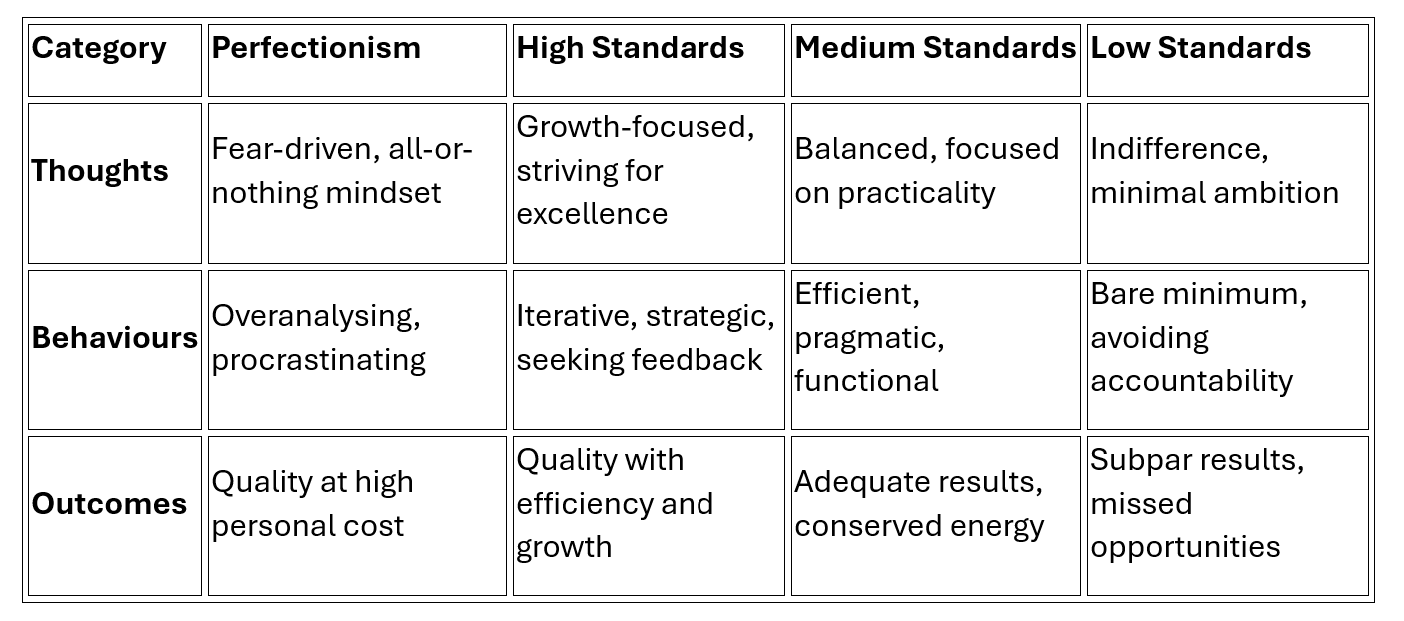
Drawing on a curious conversation between a human and large language model, we outline the thoughts, behaviours, and outcomes tied to perfectionism, high standards, medium standards, and low standards.
We discover that most of the distinctions are subtle and invisible. Internal thought patterns, personal emotional responses, and behaviours that may lie away from the gaze of others. How confident should we be, therefore, to label the invisible in others?
Perfectionism
Thoughts:
"Anything less than perfect is unacceptable."
"If I make a mistake, it means I’ve failed."
"I need to eliminate every flaw or people will judge me negatively."
Behaviours:
Overanalysing and repeatedly redoing work to avoid any imperfection.
Delaying completion due to fear of falling short.
Avoiding challenges or risks to prevent failure.
Outcomes:
High-quality results, but at the cost of time, energy, and mental health.
Missed opportunities due to fear of imperfection.
Burnout and dissatisfaction from unattainable expectations.
High Standards
Thoughts:
"I want my work to reflect effort and excellence."
"Mistakes are learning opportunities."
"Striving for high quality feels meaningful and rewarding."
Behaviours:
Setting clear, ambitious goals while staying realistic.
Seeking feedback early and making iterative improvements.
Balancing effort with time constraints to maximize impact.
Outcomes:
High-quality results delivered efficiently.
Growth and development from learning through feedback.
A sense of pride and fulfilment in achievements.
Medium Standards
Thoughts:
"This just needs to get done well enough to serve its purpose."
"Mistakes are acceptable as long as they don’t disrupt the outcome."
"I want a balance between quality and effort."
Behaviours:
Completing tasks to a functional level without overinvesting.
Prioritising practicality and efficiency over perfection.
Making reasonable trade-offs between quality and time.
Outcomes:
Satisfactory results that meet basic needs without overextending.
More time and energy to give to other tasks or priorities.
Limited potential for excellence or refinement.
Low Standards
Thoughts:
"This is fine as long as it’s done."
"Mistakes don’t matter much."
"Putting in extra effort isn’t worth it."
Behaviours:
Doing the bare minimum to complete tasks.
Ignoring opportunities for improvement.
Avoiding feedback or accountability.
Outcomes:
Inconsistent or subpar results.
Missed chances for personal or professional growth.
Lack of fulfilment or pride in the work.
Table of differences
Conclusion
Most distinctions between perfectionism, high standards, medium standards, and low standards are subtle and invisible. For instance, the stress of perfectionism or the complacency of low standards is often only felt by the individual. The impact of these hidden mental processes typically becomes evident only when they lead to tangible outcomes, like burnout from impossible standards or stagnation from missed opportunities to improve. Understanding these distinctions - both in ourselves and others - requires self-awareness and reflection beyond surface-level behaviour.
Internal thought patterns, emotional responses, and underlying behaviours are deeply personal, and often not the least bit clear to others. While we might be tempted to make educated guesses based on external cues, we are tempted to err. People are skilled at masking their inner states, including from themselves. Even with the best intentions, our view into the inner world of another is mostly blocked. But curiosity and communication can form the bridge between my invisible and yours.
Recognising where you fall on the spectrum of standards for different tasks and situations can help you strike the right balance between quality, efficiency, and personal satisfaction. Adjusting your approach based on the context allows you to achieve meaningful results without undue mental hardship or unproductive effort.
A question
Do you feel more inclined to label correctly, or choose not to label at all?
Related ideas
Beauty as imperfect. Flawed. But on the right side.
We tend to scan to the future or the past. But we can connect with the present moment and value it as good enough.
People who believe themselves to be very good are rarely so; a keen sense of our bad tendencies provides us with heightened protection against them. We don’t need to believe in the literal story of genesis to derive benefit from its moral. There is nothing as insufferable or as dangerous as people who hold themselves to be “pure”. Growing at ease with the peculiar idea that we are “sinners” readies us for the imperfect lives we are fated to lead - while bolstering our capacities for compassion and love.
Our work will at least have distracted us, it will have provided a perfect bubble in which to invest our hopes for perfection, it would have focused our measurable anxieties on a few relatively small scale and achievable goals, it will have given us a sense of mastery, it would have made us respectively tired, it will have put food on the table. It would have kept us out of greater trouble.
It's easier to think in black and white, things are all this or all that, this is an example of the power of binary bias, it's perfectly possible to be good and evil in one person. But the awkwardness often gets erased in favour of two group clarity.